Tea Tree
Melaleuca alternifolia
An Australian paperbark tree from the swampy coasts of New South Wales, with soft needle-like leaves full of oil.
- Family
- Myrtle family (Myrtaceae)
- Oil from
- Leaves
What it looks like
A shrub or small tree up to 7 m with whitish, papery bark that peels in thin layers. The leaves are narrow and soft, 1–3.5 cm long; hold one up to the light and you can see the dots of oil glands.
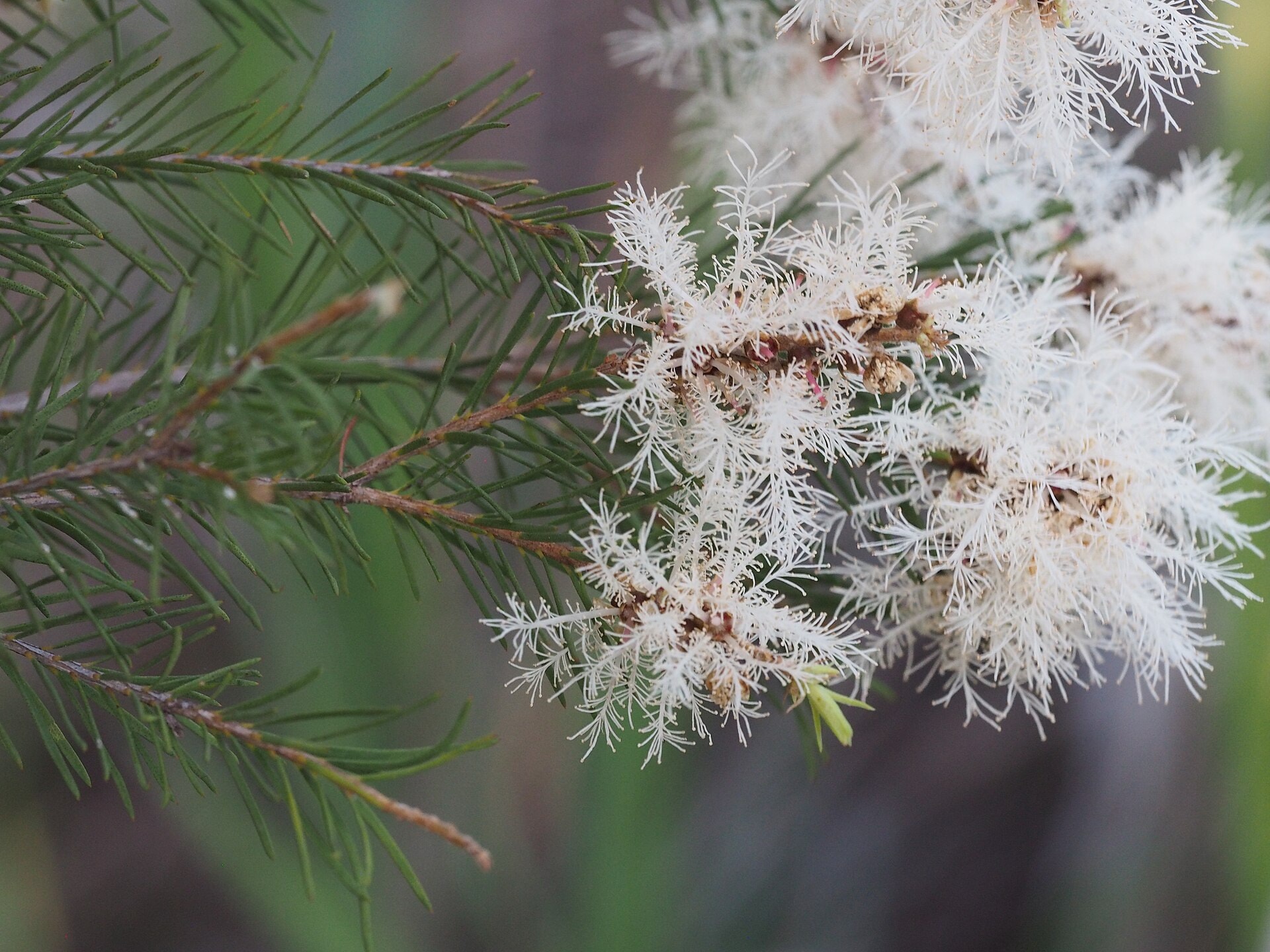
In spring the branches are covered with fluffy white flowers that look like little bottle brushes.
Where it grows
It grows wild only in Australia — along streams and in swampy lowlands of northern New South Wales and southern Queensland. Almost all tea tree oil comes from plantations in the same region.
What the oil is made of
Main constituents of the essential oil and their molecular formulas. Shares vary with harvest, origin and distillation.
- C10H18OTerpinen-4-ol35–48% · typical share
- C10H16γ-Terpinene14–28% · typical share
- C10H18Oα-Terpineol1.5–8% · typical share
How it may help
Aboriginal Australians used crushed tea tree leaves long before the oil was distilled commercially in the 1920s.
EMA recognises tea tree oil as a traditional herbal medicine applied to the skin for small superficial wounds, insect bites, small boils and mild acne, and for itching in mild athlete’s foot; and in the mouth for minor inflammation of the mouth lining.
This refers to registered herbal medicines with set doses, not to cosmetic or food-grade oils.
Laboratory studies show clear antiseptic activity. In people, a small amount of evidence suggests the oil on the skin may help with acne and athlete’s foot, though perhaps less than standard treatments (NCCIH); EMA notes that the studies were small and weakly designed. A 2023 systematic review summarises the randomised trials.
For information only. This is not medical advice and does not replace a doctor. Essential oils are not medicines and are not intended to diagnose, treat, cure or prevent any disease.
How to use
- On skin
Mix 1–2 drops with a teaspoon (5 ml) of a carrier oil such as almond or jojoba and massage into the skin — shoulders, hands or feet. Try it on a small patch of skin first.
- On skin
Add 1 drop to a single portion of unscented shampoo or face wash in your palm.
Safety
From the EU label: possible skin sensitivity. Keep out of reach of children. If you are pregnant or under medical treatment, ask your doctor first. Avoid the eyes, inner ears and sensitive areas.
Never swallow tea tree oil: taken by mouth it can cause confusion, loss of balance and even coma (NCCIH). Medicines with tea tree oil are for adults and adolescents over 12; burning, redness and allergic reactions can occur (EMA). Tea tree oil is also toxic to cats and dogs — keep it away from pets.
Store the bottle tightly closed, away from heat and light: oxidised oil irritates the skin more easily.
Sources
- European Medicines Agency — Melaleucae aetheroleum - herbal medicinal product
- NCCIH (U.S. National Institutes of Health) — Tea Tree Oil: Usefulness and Safety
- Efficacy and safety of Melaleuca alternifolia (tea tree) oil for human health-A systematic review of randomized controlled trials. Frontiers in Pharmacology, 2023
In the shop
Herbarium
All plants