Cinnamon
Cinnamomum verum (C. zeylanicum)
True cinnamon from Sri Lanka: a laurel-family tree whose inner bark curls into delicate quills.
- Family
- Laurel family (Lauraceae)
- Oil from
- Bark
What it looks like
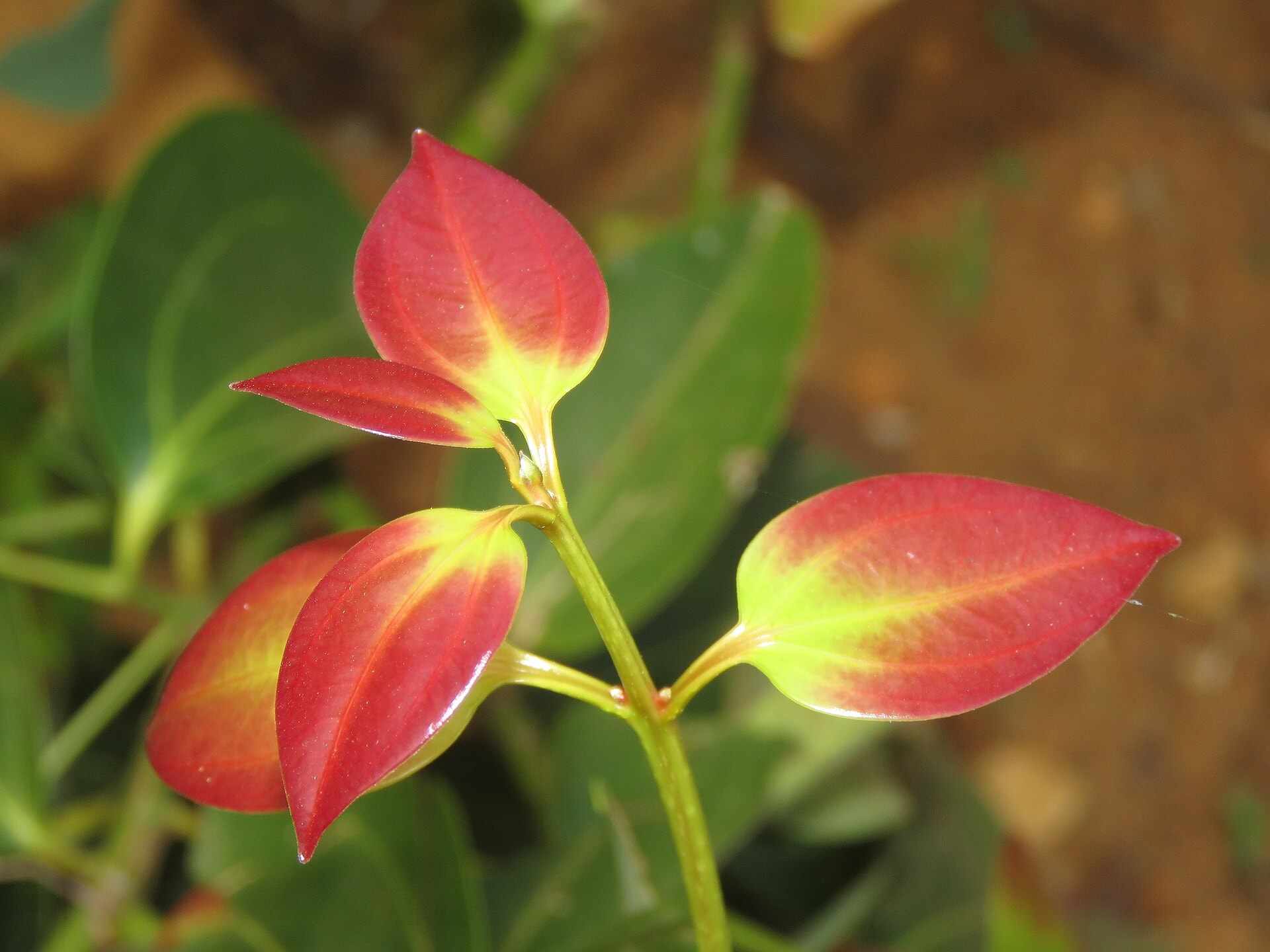
In the wild an evergreen tree 10–15 m tall; on plantations it is cut back to a bush of straight shoots. The leaves are leathery and glossy, with three prominent veins; young leaves are flushed red.
The flowers are small and yellowish, followed by dark purple berries. Workers peel the bark from young shoots, and as it dries it rolls into thin, layered quills.
Where it grows
Cinnamomum verum is native to Sri Lanka and south-west India. Sri Lanka still produces most of the world’s true cinnamon.
What the oil is made of
Main constituents of the essential oil and their molecular formulas. Shares vary with harvest, origin and distillation.
- C9H8OCinnamaldehyde
- C10H12O2Eugenol
How it may help
Cinnamon is one of the oldest traded spices: it reached ancient Egypt and Rome from the Indian Ocean long before Europeans knew where it grew.
EMA recognises cinnamon bark oil taken by mouth as a traditional herbal medicine for mild spasmodic digestive complaints, including bloating and flatulence, and notes that the undiluted oil irritates.
This refers to registered herbal medicines with set doses, not to cosmetic or food-grade oils.
According to NCCIH, research does not clearly support cinnamon for any health condition — and studies often do not even say which species or plant part was tested. A 2013 systematic review collects the research on true (Ceylon) cinnamon.
For information only. This is not medical advice and does not replace a doctor. Essential oils are not medicines and are not intended to diagnose, treat, cure or prevent any disease.
How to use
- Kitchen
The EU label allows this oil as a food flavouring: no more than 1 drop a day, always mixed into food or drink. It is very strong — dip a toothpick into the bottle and stir it in instead of adding a whole drop. Use it in cinnamon buns, porridge, hot chocolate or apple compote.
- Kitchen
The spice itself: a stick of true cinnamon in coffee, mulled wine or a slow-cooked stew.
Safety
From the EU label: use only diluted, no more than one drop a day. Keep out of reach of children. If you are pregnant or under medical care, ask your doctor. Keep away from the eyes and mucous membranes.
Cinnamon bark oil is one of the strongest skin irritants among essential oils — never put it on the skin or in the mouth undiluted. Medicines with it are not for people under 18, during pregnancy or breastfeeding, or for people allergic to cinnamon or Peru balsam (EMA).
Sources
- European Medicines Agency — Cinnamomi corticis aetheroleum - herbal medicinal product
- NCCIH (U.S. National Institutes of Health) — Cinnamon: Usefulness and Safety
- Medicinal properties of 'true' cinnamon (Cinnamomum zeylanicum): a systematic review. BMC Complementary and Alternative Medicine, 2013
- European Medicines Agency — Community herbal monograph on Cinnamomum verum J.S. Presl, corticis aetheroleum (PDF)
In the shop
Herbarium
All plants