Thyme
Thymus vulgaris
A tiny, tough Mediterranean shrub with a powerful scent — the herb of the dry hillsides.
- Family
- Mint family (Lamiaceae)
- Oil from
- Aerial parts
What it looks like
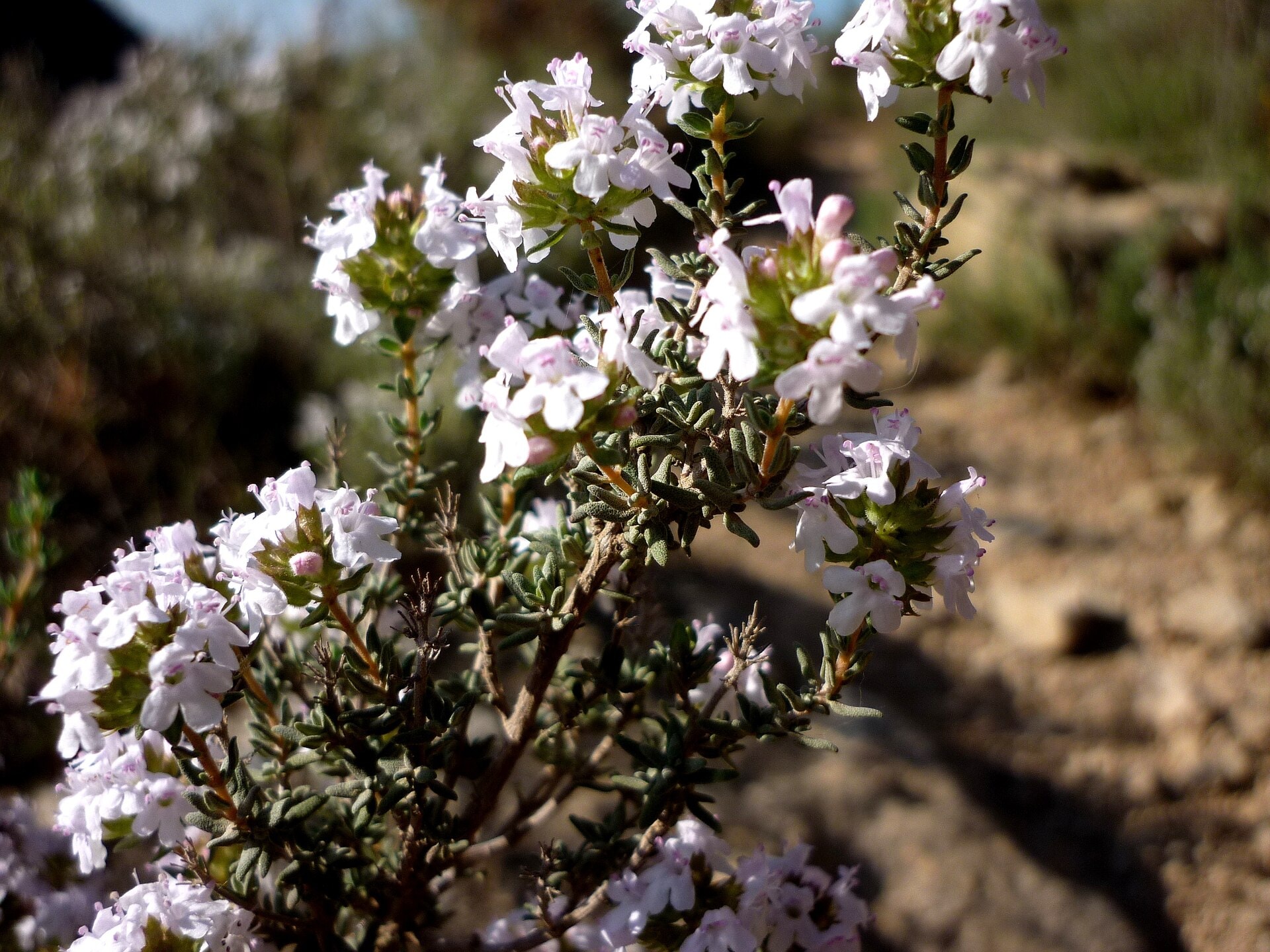
A dwarf subshrub 15–30 cm tall with a woody base and many thin, upright stems. The leaves are tiny (5–10 mm), grey-green, with rolled edges.
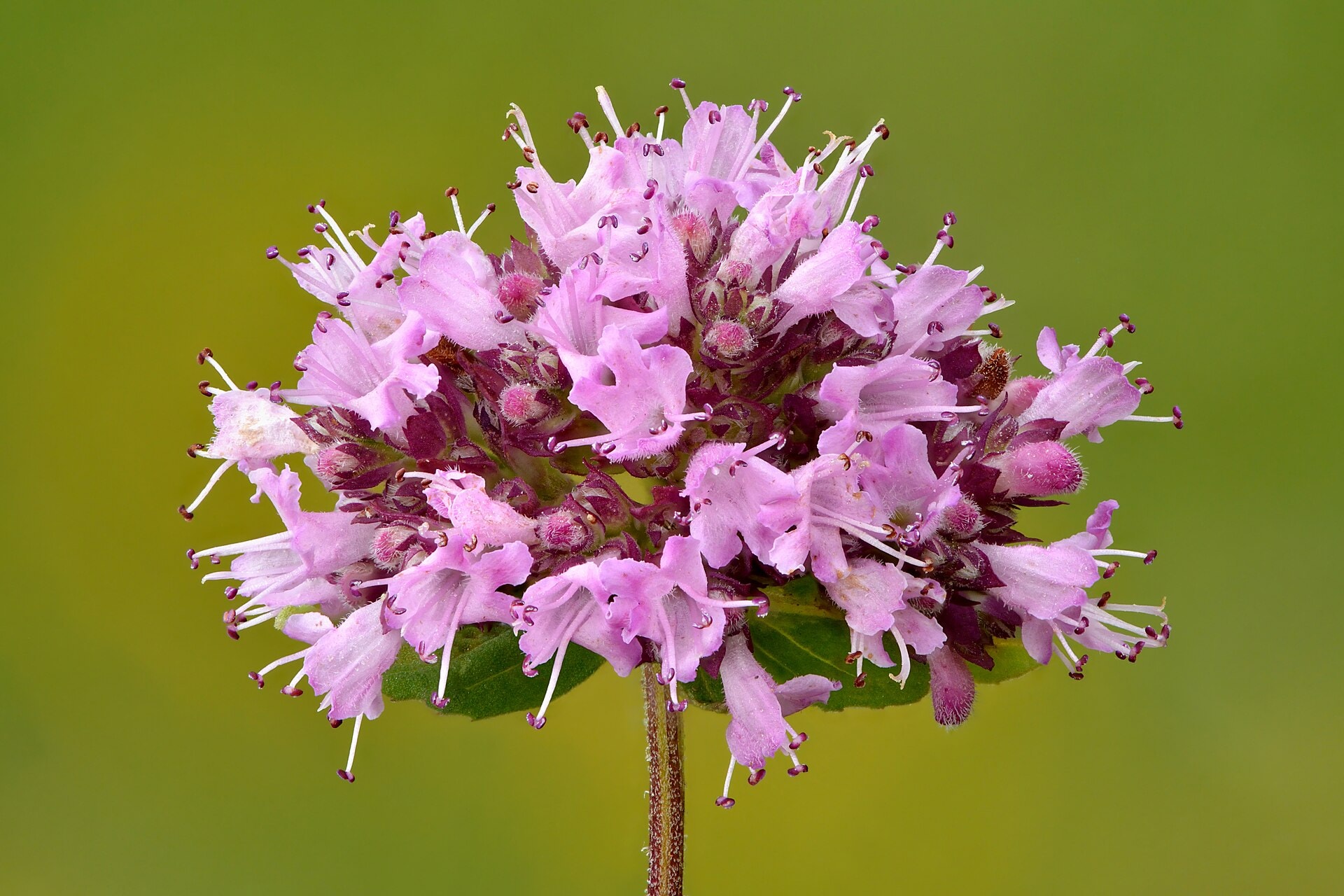
In late spring the plant is covered with small pale pink or lilac flowers arranged in whorls, which bees adore.
Where it grows
Common thyme grows on dry, stony slopes of the western Mediterranean — Spain, southern France, Italy. Cyprus has its own endemic thyme, Thymus integer, found nowhere else in the world.
What the oil is made of
Main constituents of the essential oil and their molecular formulas. Shares vary with harvest, origin and distillation.
- C10H14OThymol37–55% · typical share
- C10H14p-Cymene14–28% · typical share
- C10H16γ-Terpinene4–11% · typical share
How it may help
Ancient Greeks burned thyme in temples, and it remains a pillar of Mediterranean cooking. Thymol, its main compound, is an ingredient of some well-known mouthwashes.
EMA recognises thyme oil and thyme herb as traditional herbal medicines for productive (chesty) cough associated with colds, and thyme oil on the skin or in the bath to relieve cough and cold symptoms.
This refers to registered herbal medicines with set doses, not to cosmetic or food-grade oils.
The EMA conclusions rest on long-standing use; laboratory studies show antimicrobial activity of thyme oil, which is also used as a natural preservative. A 2020 review summarises research on thymol and thyme oil.
For information only. This is not medical advice and does not replace a doctor. Essential oils are not medicines and are not intended to diagnose, treat, cure or prevent any disease.
How to use
- Kitchen
The EU label allows this oil as a food flavouring: no more than 1 drop a day, always mixed into food or drink. It is very strong — dip a toothpick into the bottle and stir it in instead of adding a whole drop. Mix it into olive oil for a marinade or stir it into a tomato sauce.
- Kitchen
The plant itself: fresh or dried thyme with lamb, beans, potatoes and grilled fish.
Safety
From the EU label: use only diluted, no more than one drop a day. Keep out of reach of children. If you are pregnant or under medical care, ask your doctor. Keep away from the eyes and mucous membranes.
Thyme oil strongly irritates the skin. Medicines with thyme oil taken by mouth or on the skin are for adults only, bath additives for children over 3; do not apply to the face. No hot baths with the oil if you have open wounds, skin disease, high fever, severe infection, high blood pressure or heart failure (EMA).
Sources
In the shop
Herbarium
All plants