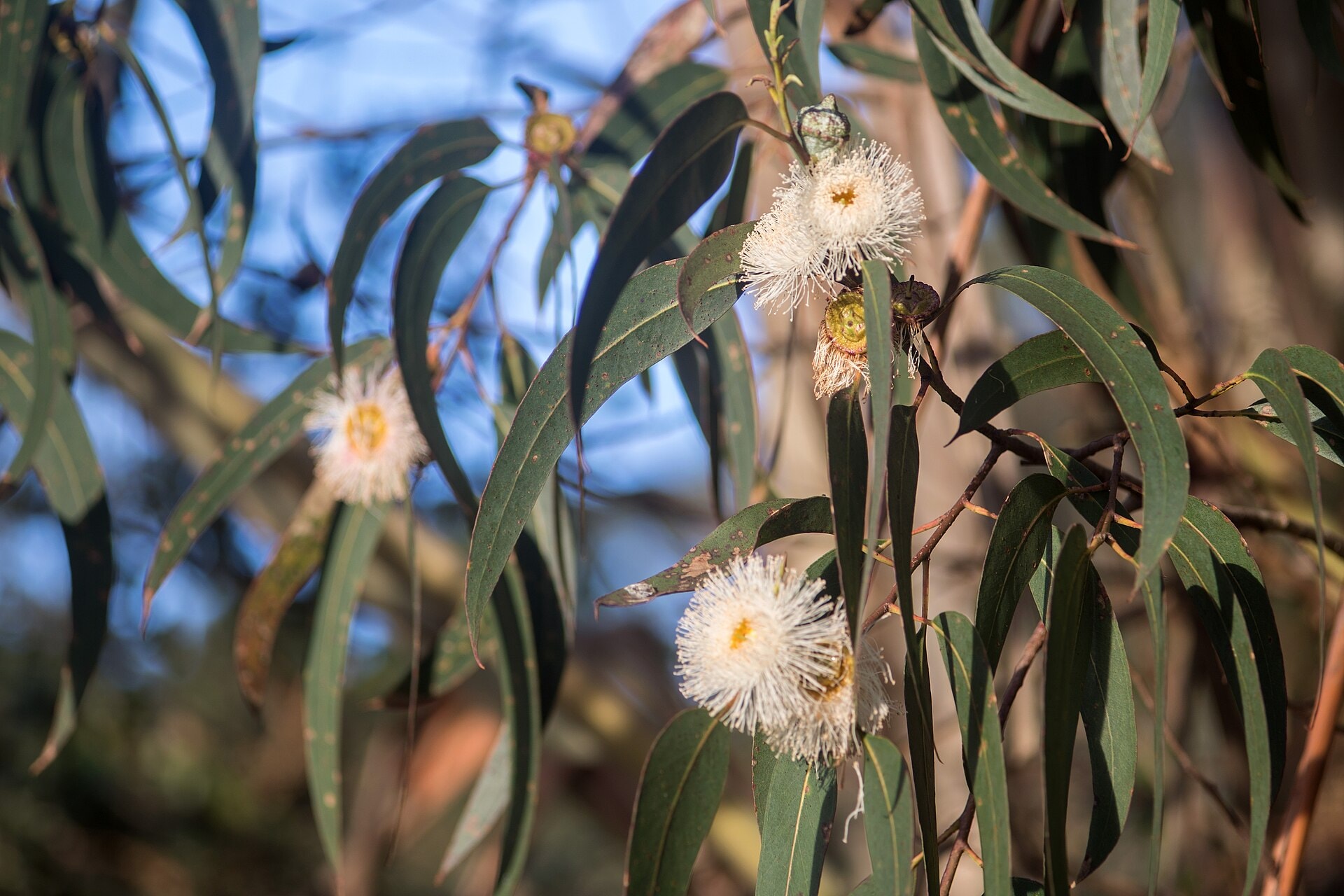
Eucalyptus
Eucalyptus globulus
Tall Australian gum trees with blue-grey leaves and bark that peels in ribbons — the source of the cool, airy 1,8-cineole.
- Family
- Myrtle family (Myrtaceae)
- Oil from
- Leaves
What it looks like
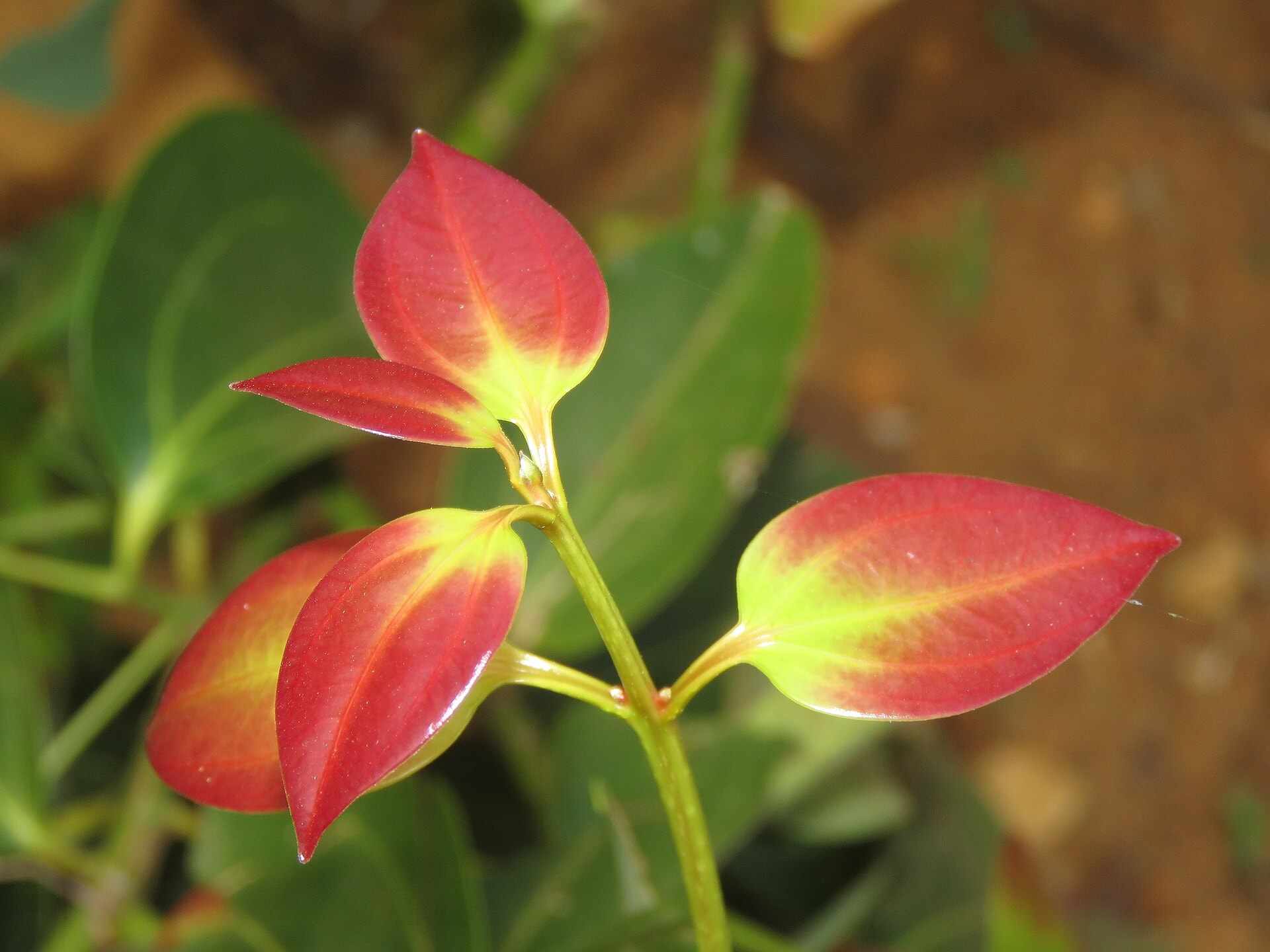
Eucalyptus oil is distilled from several species, the best known being the blue gum, Eucalyptus globulus — a tree that can reach 50 m. Young trees have round, waxy, blue-grey leaves in opposite pairs; mature branches carry long, sickle-shaped dark green leaves.
The bark sheds in long strips, revealing a smooth cream-grey trunk. The flower bud is closed by a little lid that pops off when the fluffy white stamens open.
Where it grows
Eucalypts are native to Australia and Tasmania. In the 19th and 20th centuries they were planted all around the Mediterranean — in Cyprus too, where they were used to drain marshes. Oil is produced in Australia, China, Portugal, Spain and South Africa.
What the oil is made of
Main constituents of the essential oil and their molecular formulas. Shares vary with harvest, origin and distillation.
- C10H18O1,8-Cineole (eucalyptol)
- C10H16Limonene
How it may help
Eucalyptus leaves have long been used in steam inhalations and warming chest rubs.
EMA recognises eucalyptus oil (rich in 1,8-cineole) as a traditional herbal medicine to relieve cough associated with the common cold and to relieve localised muscle pain.
This refers to registered herbal medicines with set doses, not to cosmetic or food-grade oils.
The clinical studies in bronchitis and asthma used purified 1,8-cineole rather than eucalyptus oil, so EMA could not draw firm conclusions about the oil itself. Laboratory research on the leaf oil is extensive and is summarised in a 2018 review.
For information only. This is not medical advice and does not replace a doctor. Essential oils are not medicines and are not intended to diagnose, treat, cure or prevent any disease.
How to use
- On skin
Mix 1–2 drops with a teaspoon (5 ml) of a carrier oil such as almond or jojoba and massage into the skin — shoulders, hands or feet. Try it on a small patch of skin first.
- Bath
Blend 3–5 drops with a tablespoon of carrier oil or an unscented bath base before adding it to warm water — essential oils do not mix with water on their own.
Safety
From the EU label: possible skin sensitivity. Keep out of reach of children. If you are pregnant or under medical treatment, ask your doctor first. Avoid the eyes, inner ears and sensitive areas.
Never use eucalyptus oil for children under 30 months — it can cause a spasm of the larynx — or for children who have had seizures; do not apply it on or near a child’s face. For inhalation, skin or bath, EMA allows it only from 4 years. Do not swallow the oil.
No hot baths with the oil if you have large skin injuries, acute skin disease, high fever, a severe infection, serious circulation problems or heart failure (EMA).
Sources
In the shop
Herbarium
All plants