Frankincense
Boswellia sacra
Small, tough trees of the Horn of Africa and Arabia whose resin has been burned as incense for thousands of years.
- Family
- Torchwood family (Burseraceae)
- Oil from
- Resin
What it looks like
Boswellia trees are 2–8 m tall, often with several twisted trunks and papery, peeling bark. Feathery compound leaves cluster at the tips of the branches; the flowers are small and white-yellow.
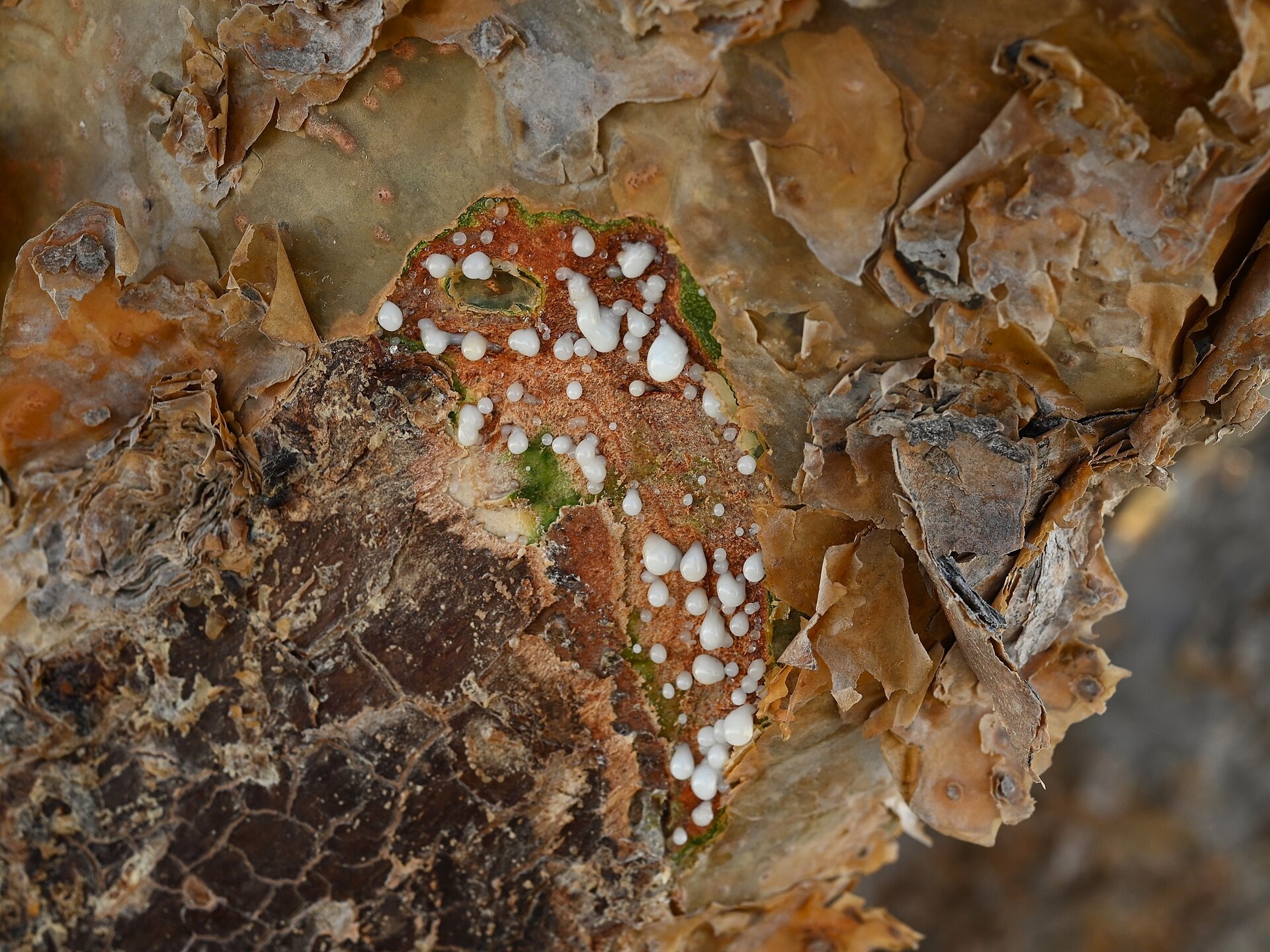
To collect the resin, harvesters make shallow cuts in the bark. A milky sap seeps out and hardens over a few weeks into translucent “tears” — the frankincense that is distilled into oil.
Where it grows
Frankincense trees grow in arid, rocky hills of Somalia, Ethiopia, Oman and Yemen — sometimes straight out of bare rock, anchored by a swollen, cushion-like base.
What the oil is made of
Main constituents of the essential oil and their molecular formulas. Shares vary with harvest, origin and distillation.
- C10H16α-Pinene
- C10H16Limonene
How it may help
Frankincense resin has been burned in temples and churches for thousands of years and was used in perfumes and cosmetics in ancient Egypt. There is no EMA monograph for frankincense oil.
Most studies on “boswellia” use resin extracts — often of a different species, Boswellia serrata — taken by mouth. Their much-discussed boswellic acids are heavy molecules that do not pass into the distilled essential oil. According to NCCIH, most studies are small and of low quality, and there is not enough good evidence that boswellia helps with any condition.
For information only. This is not medical advice and does not replace a doctor. Essential oils are not medicines and are not intended to diagnose, treat, cure or prevent any disease.
How to use
- On skin
Mix 1–2 drops with a teaspoon (5 ml) of a carrier oil such as almond or jojoba and massage into the skin — shoulders, hands or feet. Try it on a small patch of skin first.
- On skin
Add 1 drop to a single portion of your usual unscented face or body cream.
Safety
From the EU label: possible skin sensitivity. Keep out of reach of children. If you are pregnant or under medical treatment, ask your doctor first. Avoid the eyes, inner ears and sensitive areas.
Frankincense is considered likely safe on the skin; little is known about its safety in pregnancy or breastfeeding (NCCIH).
Sources
In the shop
Read in the journal
Herbarium
All plants