Roman Chamomile
Chamaemelum nobile
A low, creeping chamomile with feathery leaves that smell of apples when you step on them.
- Family
- Daisy family (Asteraceae)
- Oil from
- Flower
What it looks like
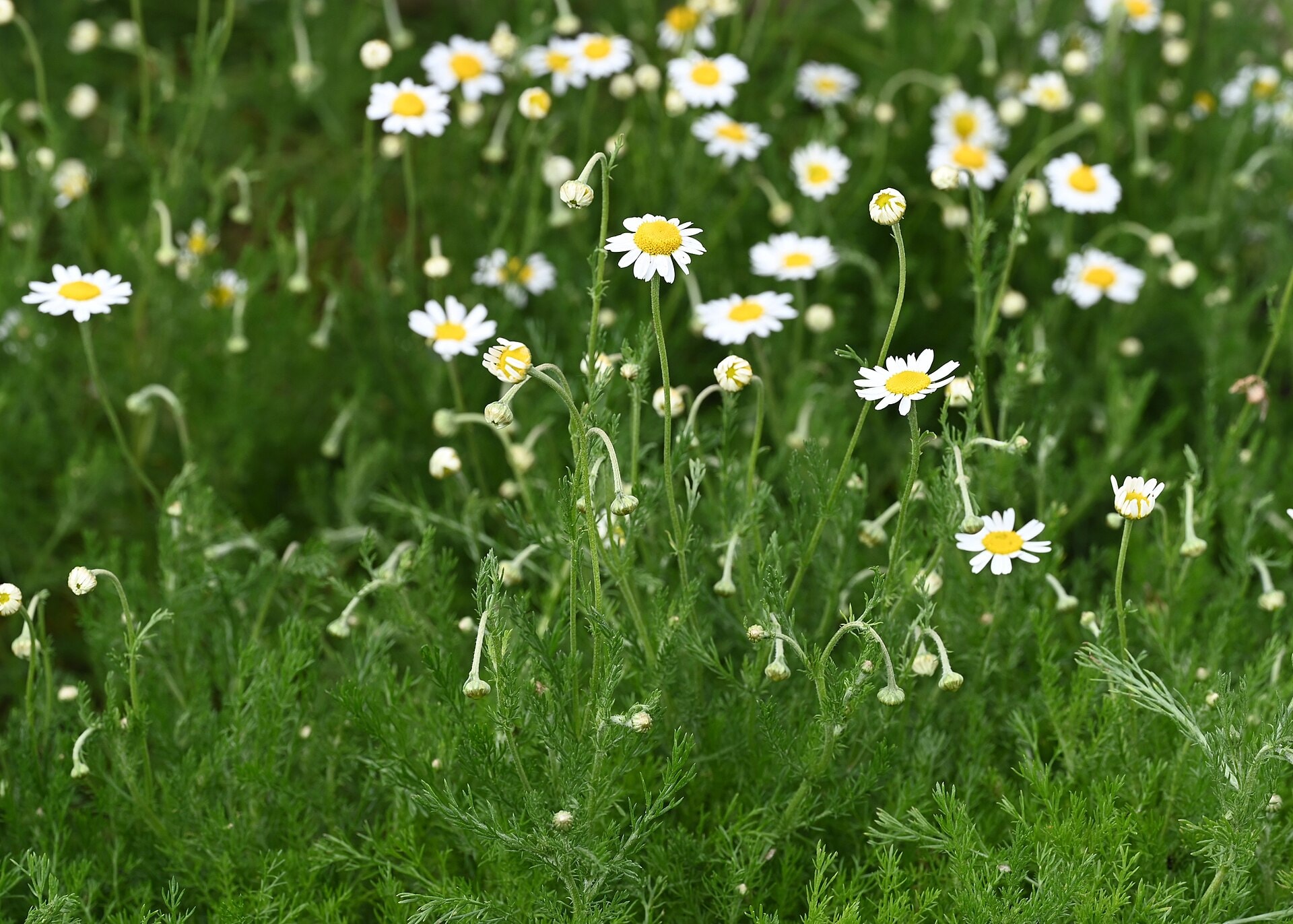
A perennial 10–30 cm tall that spreads into a soft mat. The leaves are finely divided and feathery, bright green.
From June to September it bears daisy-like flowers with white rays around a yellow, domed centre. Unlike German chamomile, the centre is solid rather than hollow, and the oil is pale yellow instead of blue.
Where it grows
Native to western Europe and North Africa, on sandy meadows and grassy roadsides. It is grown for oil in England, France, Belgium and Chile.
What the oil is made of
Main constituents of the essential oil and their molecular formulas. Shares vary with harvest, origin and distillation.
- C9H16O2Isobutyl angelate
- C10H18O2Isoamyl angelate
How it may help
Chamomile tea is one of Europe’s oldest household traditions.
EMA recognises Roman chamomile flowers — as tea or liquid extract, not the essential oil — as a traditional herbal medicine for mild spasmodic digestive complaints, including bloating and flatulence.
Clinical research on Roman chamomile oil is very limited; most work concerns German chamomile. A 2026 review compares the chemistry of the two species.
For information only. This is not medical advice and does not replace a doctor. Essential oils are not medicines and are not intended to diagnose, treat, cure or prevent any disease.
How to use
- On skin
Mix 1–2 drops with a teaspoon (5 ml) of a carrier oil such as almond or jojoba and massage into the skin — shoulders, hands or feet. Try it on a small patch of skin first.
- Bath
Blend 3–5 drops with a tablespoon of carrier oil or an unscented bath base before adding it to warm water — essential oils do not mix with water on their own.
- Kitchen
The plant itself: dried flowers (not the oil) make a mild herbal tea.
Safety
From the EU label: possible skin sensitivity. Keep out of reach of children. If you are pregnant or under medical treatment, ask your doctor first. Avoid the eyes, inner ears and sensitive areas.
Do not use if you are allergic to plants of the daisy family (Asteraceae), such as ragweed, chrysanthemums or arnica (EMA).
Sources
- European Medicines Agency — Chamomillae romanae flos - herbal medicinal product
- European Medicines Agency — Final Community herbal monograph on Chamaemelum nobile (L.) All., flos (PDF)
- German and Roman Chamomile: Species-Specific Phytochemical Profiles, Bioactive Potential, and Relevance for Functional Foods and Nutraceutical Development. Nutrients, 2026
In the shop
Herbarium
All plants