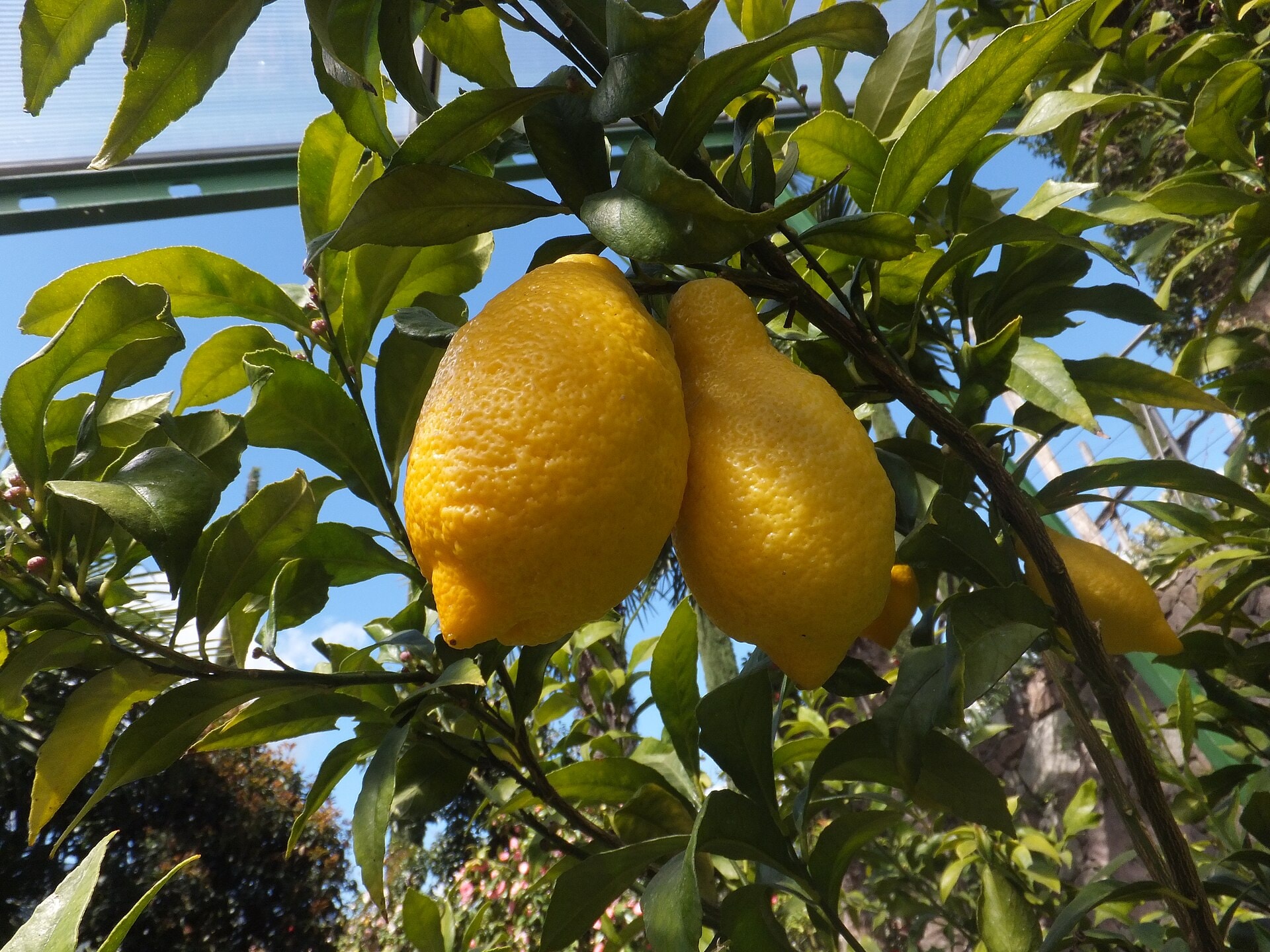
Lemon
Citrus limon
A small thorny evergreen that flowers and fruits at the same time; the oil is pressed from the bright yellow peel.
- Family
- Rue family (Rutaceae)
- Oil from
- Peel
What it looks like
A tree 3–6 m tall with thorny branches and glossy, oval leaves. The fragrant white flowers open from purple-tinged buds.
The fruit turns from green to yellow; look closely at the peel and you will see tiny dimples — each is a gland full of essential oil. That is where the oil comes from: it is cold-pressed from the peel, not distilled.
Where it grows
The lemon is an ancient hybrid of bitter orange and citron that arose in the foothills of the Himalayas. Arab traders brought it to the Mediterranean in the Middle Ages. Today the main producers are Sicily, Spain, Argentina — and lemons grow in almost every Cypriot garden.
What the oil is made of
Main constituents of the essential oil and their molecular formulas. Shares vary with harvest, origin and distillation.
- C10H16Limonene59–75% · typical share
- C10H16β-Pinene7–17% · typical share
- C10H16γ-Terpinene6–12% · typical share
How it may help
For centuries lemon has flavoured food and drinks, cleaned kitchens and freshened perfumes. There is no EMA monograph for lemon oil.
Research on lemon oil and its main compound, limonene, is mostly laboratory work, summarised in a 2020 review. Good clinical studies in people are scarce.
For information only. This is not medical advice and does not replace a doctor. Essential oils are not medicines and are not intended to diagnose, treat, cure or prevent any disease.
How to use
- Kitchen
The EU label allows this oil as a food flavouring: no more than 1 drop a day, always mixed into food or drink. Stir it into a large jug of water, a lemon cake batter or a spoon of honey in tea.
- Kitchen
The fruit itself: fresh zest carries the same aroma as the oil.
Safety
From the EU label: use only diluted, no more than one drop a day. Keep out of reach of children. If you are pregnant or under medical care, ask your doctor. Keep away from the eyes and mucous membranes.
Cold-pressed lemon oil makes skin sensitive to sunlight: after skin contact, avoid sun and UV light for 12 hours.
Sources
In the shop
Read in the journal
Herbarium
All plants