Rosemary
Salvia rosmarinus (Rosmarinus officinalis)
“Dew of the sea”: a resinous Mediterranean shrub that blooms pale blue even in winter.
- Family
- Mint family (Lamiaceae)
- Oil from
- Leaves
What it looks like
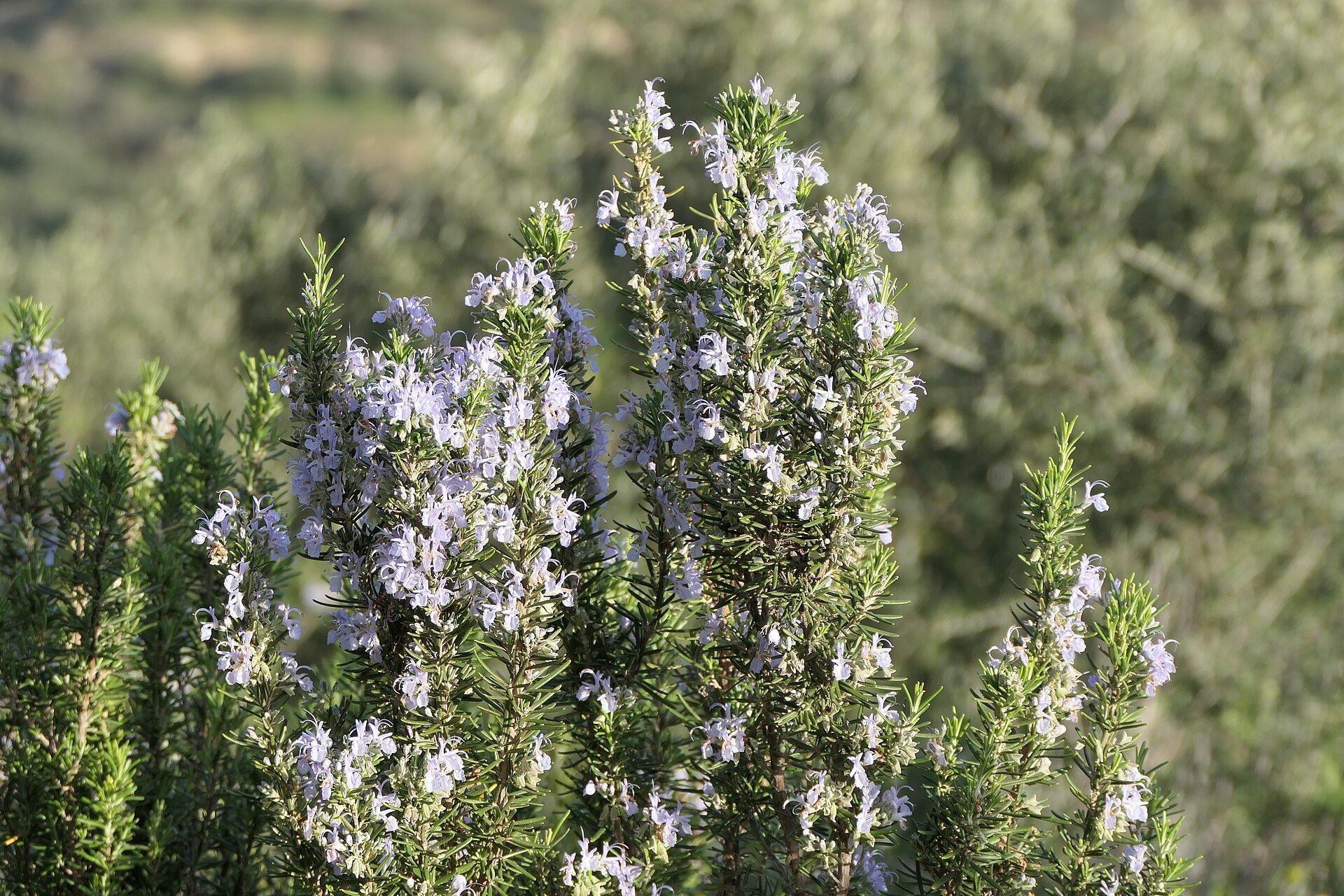
An evergreen shrub up to 1.5–2 m. The leaves look like thick needles: leathery, dark green on top and white-felted underneath, with rolled edges.
Small two-lipped flowers, pale blue to violet, sit all along the branches. In a mild climate rosemary flowers for much of the year, including winter.
Where it grows
Rosemary grows wild on dry rocky coasts and in the scrubland of the Mediterranean, and it is a classic of Cypriot gardens. Most of the oil comes from Tunisia, Morocco and Spain. Since 2017 botanists have placed it in the sage genus as Salvia rosmarinus.
What the oil is made of
Main constituents of the essential oil and their molecular formulas. Shares vary with harvest, origin and distillation.
- C10H18O1,8-Cineole (eucalyptol)38–55% · typical share
- C10H16OCamphor5–15% · typical share
- C10H16α-Pinene9–14% · typical share
How it may help
Rosemary has been a kitchen herb and a symbol of remembrance since antiquity; sprigs were woven into wedding wreaths and burned in place of incense.
EMA recognises rosemary oil in creams and ointments as a traditional herbal medicine to relieve minor muscle and joint pain and minor circulation problems in the legs. This is based only on long-standing use, not on clinical trials.
This refers to registered herbal medicines with set doses, not to cosmetic or food-grade oils.
Most research is laboratory work, summarised in a 2019 review. A small British experiment linked the amount of 1,8-cineole absorbed from rosemary aroma with performance on mental arithmetic — we retell it, with its limits, in our journal.
For information only. This is not medical advice and does not replace a doctor. Essential oils are not medicines and are not intended to diagnose, treat, cure or prevent any disease.
How to use
- Kitchen
The EU label allows this oil as a food flavouring: no more than 1 drop a day, always mixed into food or drink. Mix it into a few spoons of olive oil for roast potatoes, vegetables or focaccia.
- Kitchen
The plant itself: fresh sprigs with lamb, chicken, bread and roasted vegetables.
Safety
From the EU label: use only diluted, no more than one drop a day. Keep out of reach of children. If you are pregnant or under medical care, ask your doctor. Keep away from the eyes and mucous membranes.
Medicines with rosemary oil are not for people under 18, during pregnancy or breastfeeding, or for people with heart or kidney disease; they can cause skin reactions or asthma-like breathing difficulty (EMA). If you have epilepsy, ask your doctor before using rosemary oil.
Sources
In the shop
Read in the journal
Herbarium
All plants