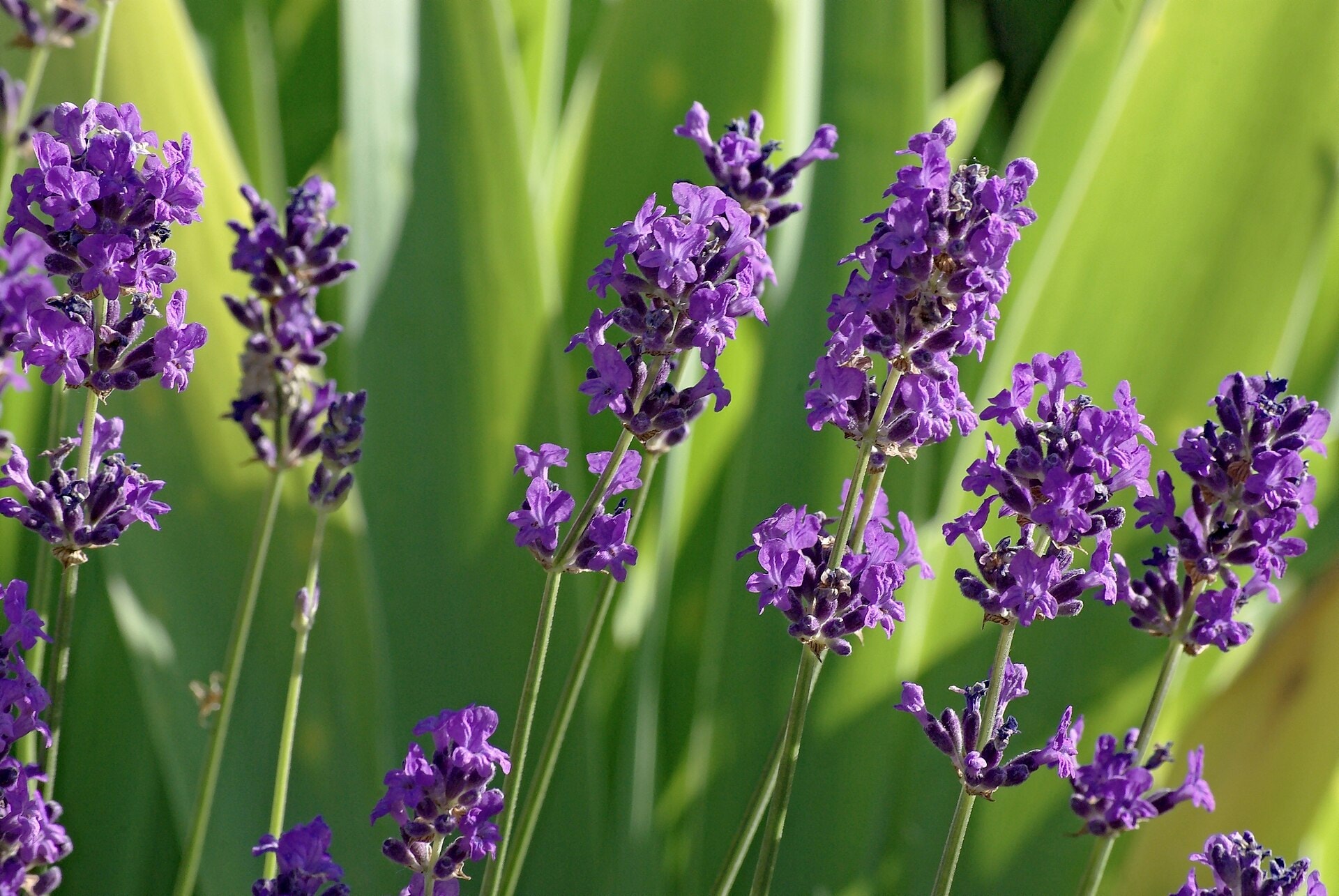
Lavender
Lavandula angustifolia
A silver-leaved Mediterranean shrub with violet flower spikes — the most familiar scent of summer fields in Provence.
- Family
- Mint family (Lamiaceae)
- Oil from
- Flower
What it looks like
An evergreen subshrub 30–60 cm tall with a woody base. The leaves are narrow, grey-green and slightly downy, with edges rolled under.
In June–August long leafless stems carry dense spikes of small violet-blue flowers. The whole plant is covered in tiny glands that hold the essential oil — that is why lavender smells as soon as you touch it.
Where it grows
Wild lavender grows on dry, sunny limestone slopes in the mountains of Spain, southern France and Italy. Today it is farmed in Provence, Bulgaria, England, Australia and beyond. It loves poor, well-drained soil and dislikes wet feet.
What the oil is made of
Main constituents of the essential oil and their molecular formulas. Shares vary with harvest, origin and distillation.
- C10H18OLinalool20–43% · typical share
- C12H20O2Linalyl acetate25–47% · typical share
How it may help
For centuries lavender has scented baths, linen and perfumes; bunches of dried flowers were tucked into wardrobes and pillows.
The European Medicines Agency (EMA) recognises lavender oil as a traditional herbal medicine: taken by mouth or added to a bath, to relieve mild symptoms of mental stress and exhaustion and to aid sleep. The conclusion is based on long-standing use.
This refers to registered herbal medicines with set doses, not to cosmetic or food-grade oils.
An oral lavender oil preparation has been studied in anxiety; reviews find a modest effect, but the studies are small and often industry-funded. Whether lavender aromatherapy helps with anxiety, stress or sleep is still unclear, according to the US National Center for Complementary and Integrative Health (NCCIH). We retell a large review in our journal.
For information only. This is not medical advice and does not replace a doctor. Essential oils are not medicines and are not intended to diagnose, treat, cure or prevent any disease.
How to use
- On skin
Mix 1–2 drops with a teaspoon (5 ml) of a carrier oil such as almond or jojoba and massage into the skin — shoulders, hands or feet. Try it on a small patch of skin first.
- Bath
Blend 3–5 drops with a tablespoon of carrier oil or an unscented bath base before adding it to warm water — essential oils do not mix with water on their own.
- Home
The plant itself: dried lavender flowers in a linen bag keep wardrobes and drawers fresh.
Safety
From the EU label: possible skin sensitivity. Keep out of reach of children. If you are pregnant or under medical treatment, ask your doctor first. Avoid the eyes, inner ears and sensitive areas.
Allergic skin reactions are possible (NCCIH). Medicines based on lavender oil are for adults and children over 12; full baths with the oil are not advised for people with open wounds, skin disease, high fever, severe infection or serious heart and circulation problems (EMA).
Store the bottle tightly closed, away from heat and light: oxidised oil irritates the skin more easily.
Sources
In the shop
Read in the journal
Herbarium
All plants